1. 🎳 Ball-and-Socket Kinematics
- Mechanism: The hip joint consists of a spherical femoral head and a deep acetabulum, engineered as a multi-axial joint for movement across all three spatial planes.
- Kinetic Impact: Provides maximum Range of Motion (ROM), allowing the body to flex and extend deeply without reaching the bony end-feel threshold.
- 🧘 Yoga Application: Baddha Konasana (Bound Angle Pose) – Maximizing external rotation of the femoral head within the acetabulum without inducing torsional stress on the pelvis.
- 📚 Ref: Kapandji, I. A. (2008). The Physiology of the Joints, Vol 2.
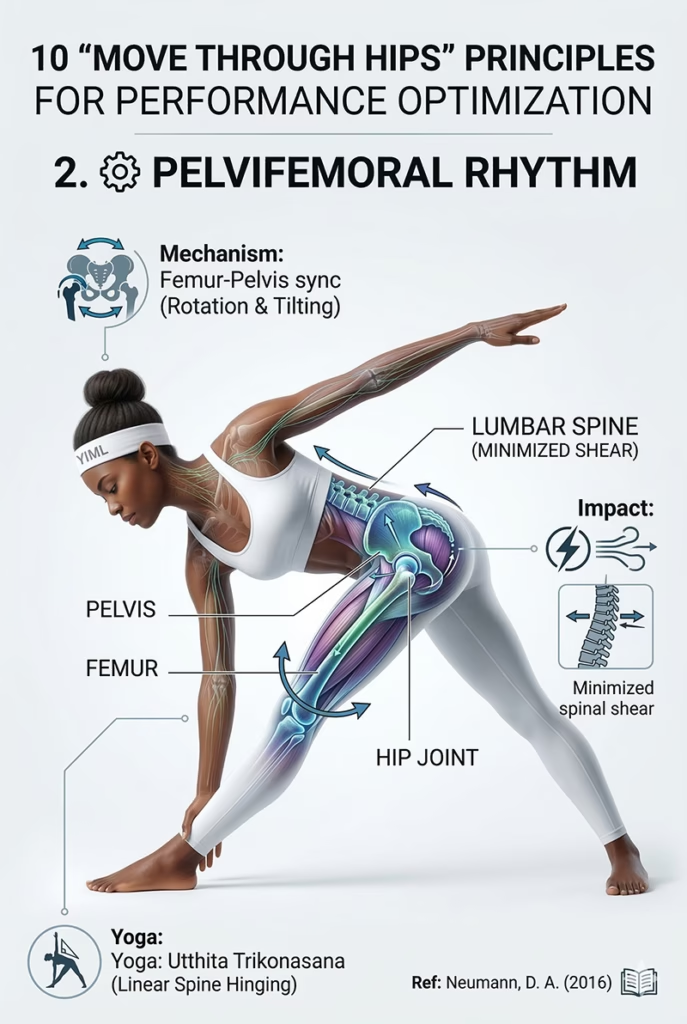
2. ⚙️ Pelvifemoral Rhythm
- Mechanism: The synchronized kinematic coordination between the rotation of the femur within the joint capsule and the tilting of the pelvis.
- Kinetic Impact: Facilitates seamless kinetic energy transfer from the lower extremities to the upper body, minimizing shear stress along the spinal segments.
- 🧘 Yoga Application: Utthita Trikonasana (Triangle Pose) – Deep hip hinging in the front leg allows the pelvis to rotate open while keeping the spinal axis perfectly linear.
- 📚 Ref: Neumann, D. A. (2016). Kinesiology of the Musculoskeletal System.
3. 🚀 Posterior Chain Prime Mover
- Mechanism: Utilizing the Gluteus Maximus as the primary engine (prime mover) for hip extension and upward propulsion.
- Kinetic Impact: Generates the body’s most powerful propulsive force, completely offloading the small erector spinae muscles of the lumbar spine.
- 🧘 Yoga Application: Virabhadrasana I (Warrior I) – Isometrically contracting the rear glute to extend the hip, creating a biomechanical launchpad to elevate the thorax.
- 📚 Ref: Long, R. (2006). The Key Muscles of Yoga.
4. 🔒 Lumbar Spine Sparing
- Mechanism: Prioritizing hip flexion as the primary movement source before significant lumbar flexion occurs.
- Kinetic Impact: Prevents spinal “wear and tear” caused by forcing the lumbar spine to flex compensatorily for restricted hip mobility.
- 🧘 Yoga Application: Uttanasana (Forward Fold) – Hinging strictly from the anterior hip crease; the spine is only allowed to hang passively at the absolute endpoint.
- 📚 Ref: McGill, S. (2015). Low Back Disorders.
5. 🧩 Hip-Spine Dissociation
- Mechanism: Training the neuromuscular system to control femoral movement completely independently of the pelvis and lumbar spine.
- Kinetic Impact: Eradicates the pathological compensatory spasms of the Quadratus Lumborum (QL) whenever lifting a leg or rotating the torso.
- 🧘 Yoga Application: Supta Padangusthasana (Reclining Hand-to-Big-Toe Pose) – The femur rotates and flexes while the lumbar spine remains firmly imprinted into the mat.
- 📚 Ref: Neumann, D. A. (2016). Kinesiology.
6. 🌪️ Active External Rotation
- Mechanism: Activating the deep external rotators of the hip (Deep 6) to optimize femoral head positioning within the acetabulum..
- Kinetic Impact: Prevents femoroacetabular impingement (FAI) between the femoral neck and the acetabular labrum during deep flexion.
- 🧘 Yoga Application: Malasana (Garland Pose) – Actively externally rotating the femurs to widen the knees, creating an open pathway for the pelvis to sink deeply without rounding the spine.
- 📚 Ref: Kaminoff, L. (2011). Yoga Anatomy.
Interestingly, mastering hip-dominant movement is not only about performance—it is also one of the most effective strategies for preventing and managing low back pain.
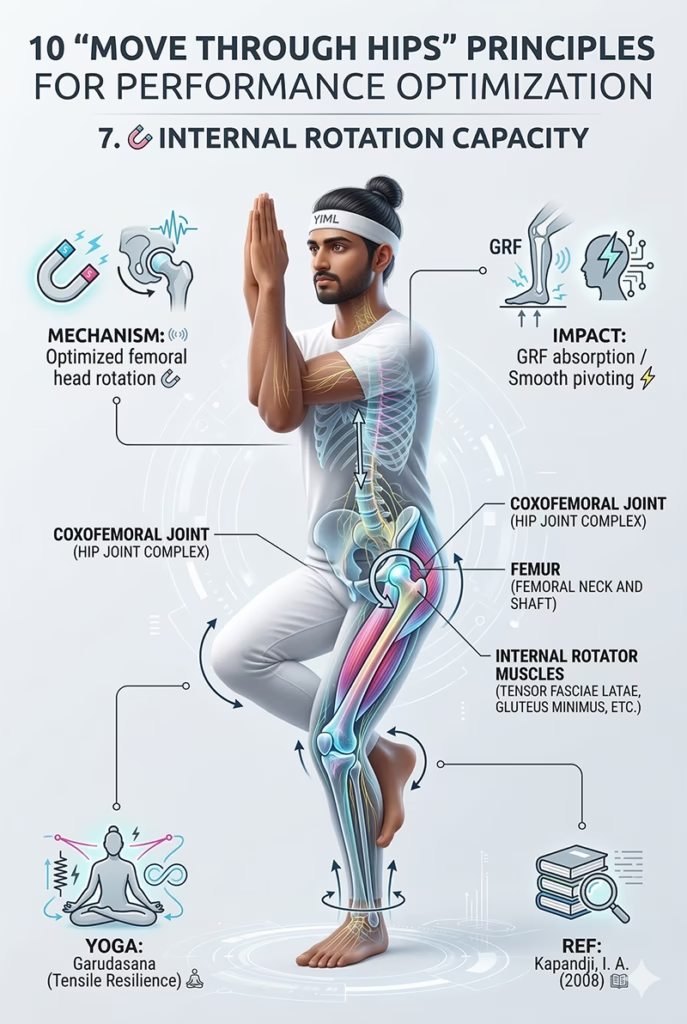
7. 🧲 Internal Rotation Capacity
- Mechanism: Optimizing the internal rotation capacity of the femoral head to balance intra-articular pressure.
- Kinetic Impact: Allows the body to pivot smoothly, absorbing Ground Reaction Forces (GRF) when moving across asymmetrical planes.
- 🧘 Yoga Application: Garudasana (Eagle Pose) – Deep internal rotation and adduction of the thighs, building tensile resilience in the hip joint capsule and ligaments.
- 📚 Ref: Kapandji, I. A. (2008). The Physiology of the Joints.
8. 🏹 Hamstring Bowstringing
- Mechanism: Transforming the hamstrings into an elastic bowstring to eccentrically brake the hip flexion movement.
- Kinetic Impact: Provides eccentric braking of hip flexion, protecting the posterior chain from excessive tensile loading.
- 🧘 Yoga Application: Prasarita Padottanasana (Wide-Legged Forward Fold) – The hamstrings tense evenly on both sides, eccentrically controlling the descent rate of the upper body.
- 📚 Ref: Long, R. (2006). The Key Muscles of Yoga.
9. ⚖️ Bilateral Hip Symmetry
- Mechanism: Distributing flexion and rotation forces equally into both acetabula during symmetrical closed-chain postures.
- Kinetic Impact: Prevents pelvic torsion, which is the leading biomechanical cause of spinal axial deviation and scoliotic compensation.
- 🧘 Yoga Application: Utkatasana (Chair Pose) – Both hips hinge deeply backward with absolute bilateral symmetry in ROM and force generation.
- 📚 Ref: Neumann, D. A. (2016). Kinesiology.
10. 🧱 Closed Kinetic Chain Hip Stabilization
- Mechanism: The foot remains fixed to the ground, creating a closed kinetic chain that allows the pelvis to rotate around a stabilized femoral head.
- Kinetic Impact: Maximally activates the Gluteus Medius to maintain frontal-plane pelvic stability.
- 🧘 Yoga Application: Ardha Chandrasana (Half Moon Pose) – Rotating the entire pelvis over the fulcrum of a single hip joint, demanding extreme core and gluteal stabilization.
- 📚 Ref: McCall, T. (2007). Yoga as Medicine.
📥 Access the complete 50 Yoga Flashcards system—including the Move Through Hips Master Bundle and Spine Biomechanics Library (5 PDFs) on Etsy