
Part 1: Introduction
Knee Osteoarthritis (KOA) is a leading cause of disability in older adults, affecting hundreds of millions globally. Persistent pain discourages movement, leading to muscle atrophy, joint stiffness, and increased pain—a pathological vicious cycle.
Currently, the First-line non-pharmacological treatment recommended by global medical associations is Strengthening Exercises, specifically targeting the quadriceps to offload the knee joint. However, clinical reality shows low patient adherence to these protocols. Traditional resistance exercises can be monotonous, repetitive, and may induce pain if performed with incorrect technique.
The critical question arises: Is there a more engaging, accessible alternative that achieves equivalent clinical outcomes?
Yoga, with its integration of physical movement, stretching, and mental relaxation, is a promising candidate. But is Yoga truly robust enough to replace weight training or resistance drills in reducing knee pain? A landmark study recently published in JAMA Network Open provides direct, high-quality clinical evidence.
Study Overview
This is a Gold Standard clinical trial, conducted to directly compare the efficacy of Yoga against traditional Strengthening Exercises.
- Title: Yoga vs Strengthening Exercise for Knee Osteoarthritis: A Randomized Clinical Trial.
- Authors: Rachelle Buchbinder, Benny Antony, et al.
- Year: 2025
- Journal: JAMA Network Open (Open access journal of the American Medical Association – High Impact Factor).
- Link: https://jamanetwork.com/journals/jamanetworkopen/fullarticle/2832290
- DOI: 10.1001/jamanetworkopen.2025.3698

Why is this study highly credible?
- Head-to-Head Design: Unlike previous studies that compared Yoga to “no intervention” or “health education,” this study dared to compare Yoga against the current Gold Standard treatment (Strengthening).
- Objectivity: The study utilized Blinded Assessors, meaning the researchers evaluating the results did not know which group the patients belonged to, eliminating bias.
- Follow-up Duration: Patients were monitored closely for 24 weeks (6 months), sufficient to evaluate the sustainability of the intervention.
Part 2: Objectives & Scientific Hypothesis
Primary Objective The study aimed to determine if a 12-week Yoga program is non-inferior (no less effective) to a traditional strengthening program for reducing knee pain.
Mechanistic Hypothesis Researchers posited that Yoga is not merely stretching. Standing postures (e.g., Virabhadrasana / Warrior, Utkatasana / Chair) generate isometric contractions, strengthening the peri-articular muscles without creating the sheer friction on the cartilage often caused by repetitive flexion-extension exercises. Furthermore, the mindfulness component of Yoga helps modulate central pain processing.
Part 3: Methodology (PICO)
- Participants: 117 adults over 40 (mean age ~62) diagnosed with symptomatic Knee Osteoarthritis. All had knee pain during activity rated at least 40/100 on the VAS scale.
- Intervention (Yoga Group): Participated in a specialized Yoga program for knees (modified Hatha Yoga).
- Frequency: 3 sessions/week for the first 12 weeks (2 supervised + 1 home practice).
- Maintenance Phase (Weeks 13–24): 3 home practice sessions per week.
- Comparison (Strengthening Group): Participated in a standard leg strengthening program.
- Exercises included: Leg press, Knee extension, Hamstring curls, etc.
- Frequency: Matched the Yoga group (3 sessions/week).
- Outcomes:
- Primary: Change in pain scores on the Visual Analog Scale (VAS) after 12 weeks.
- Secondary: WOMAC Scores (pain, stiffness, physical function), Quality of Life, and muscle strength.

Part 4: Results
The findings bring excellent news to the Yoga Therapy community, solidifying Yoga’s position in rehabilitative medicine.
1. Pain Relief: Yoga Rivals the Gym
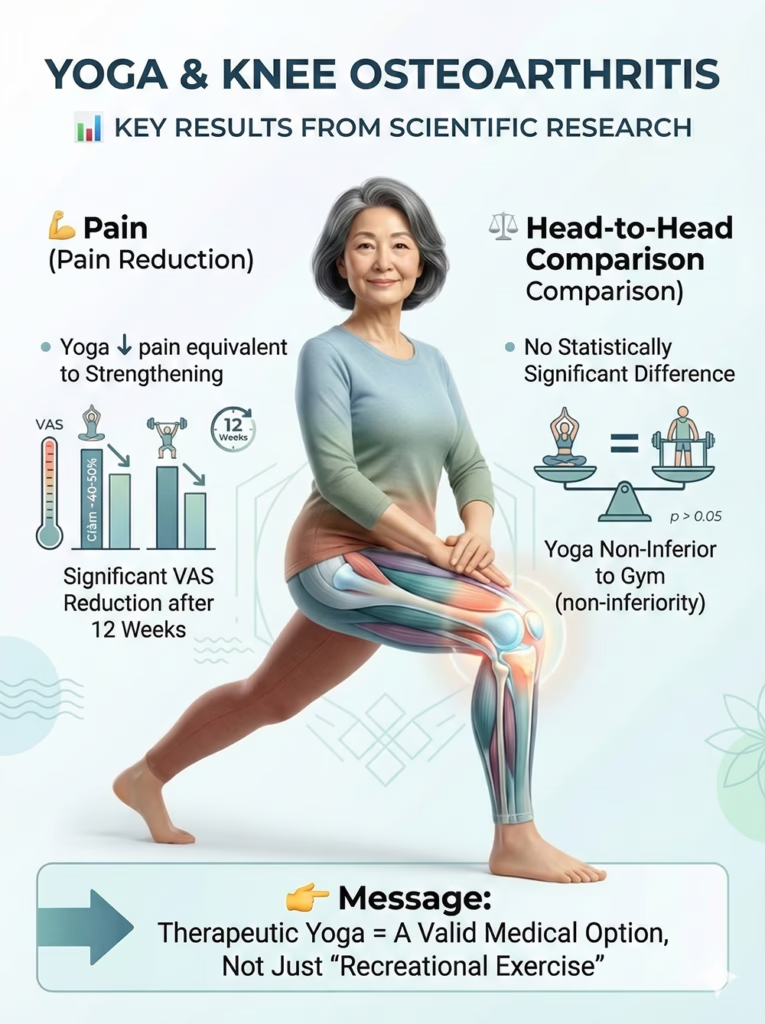
After 12 weeks of active intervention, both groups reported significant pain reduction.
- Yoga Group: Showed a robust decrease in VAS pain scores.
- Strengthening Group: Showed similar reductions.
- Head-to-Head Comparison: The difference in pain reduction between the two groups was not statistically significant (the mean difference fell within the “non-inferiority margin”).
- Clinical Significance: This proves Yoga is therapeutically equivalent to intensive physical therapy exercises for pain management. Patients can confidently choose Yoga over the gym if they prefer a lower-impact approach.
2. Functional Mobility (WOMAC Score)
Beyond pain relief, the Yoga group’s ability to walk, climb stairs, and perform sit-to-stand movements improved markedly, paralleling the strengthening group. This debunks the myth that “Yoga is just for relaxation, not leg strength.” In reality, balance poses and weight-bearing asanas effectively enhance functional mobility.

3. Adherence & Preference
While both groups were supervised, dropout rates in Yoga interventions generally tend to be lower in broader literature. Yoga offers mental well-being benefits and feels less like a “clinical treatment” compared to repetitive rehabilitation drills.
4. Safety Profile
Over the 24-week follow-up, the number of adverse events (e.g., increased pain, new injuries) in the Yoga group was very low and non-serious. This confirms that a medically designed Yoga program is safe for older adults with osteoarthritis.

Part 5: Discussion
Why can slow, deliberate Yoga movements replace massive leg-strengthening machines? This discussion delves into the biomechanical and neurological mechanisms behind the results.
1. “Smart” Strengthening Mechanism (Isometric vs. Isotonic)
In physical therapy, there are two primary methods for strengthening muscle:
- Isotonic (Dynamic): Muscles contract and lengthen continuously (e.g., leg extensions, squats). While effective, this creates significant friction and shear force on an already degenerating knee joint.
- Isometric (Static): Muscles generate high tension without changing length, and the joint angle remains static.

Yoga predominantly utilizes Isometric contraction. For example, holding Virabhadrasana II (Warrior II) for 30 seconds requires intense activation of the quadriceps to stabilize the knee, yet the joint itself does not undergo repetitive flexion-extension. This is the safest strengthening method for osteoarthritic joints.
The biomechanical demands of these weight-bearing postures in older adults are analyzed in our review of standing yoga for seniors.
2. Enhancing Proprioception (Joint Position Sense)
Patients with OA often lose proprioception—the innate sense of joint position—leading to gait instability and fall risk. Balancing poses in Yoga (like Vrksasana / Tree Pose) force the nervous system to re-map the knee joint, fostering joint stability via neural control rather than just muscle bulk.
3. The Mind-Body Impact on Pain
Chronic knee pain is not solely located in the joint; it involves Central Sensitization of the nervous system. Yoga reduces psychological stress, activates the parasympathetic nervous system, and raises the patient’s pain threshold. Even with the same level of cartilage damage, a Yoga practitioner perceives less pain and distress compared to a non-practitioner. Evidence: The Influence of Yoga on the Brain in Relation to Motor Performance, Body Awareness and Pain (DOI: 10.1016/j.ctim.2019.03.021)
We have decoded this autonomic regulation mechanism in detail in our randomized trial analysis on Hatha yoga and stress.

Clinical Application (The Rheumatologist’s Perspective)
This JAMA study provides Level A Evidence, empowering physicians to evolve their counseling strategies:
- Diversify the “Exercise Prescription”: Instead of merely advising “go cycle or lift weights,” physicians can confidently prescribe: “Therapeutic Yoga, 3 sessions/week.” This is an excellent alternative for female patients, the elderly, or those averse to the gym environment.
- Personalized Medicine: For patients with a low pain threshold and kinesiophobia (fear of movement), Yoga serves as the perfect bridge. It re-introduces movement gently before progressing to higher-intensity loading.
- Referral Caution: While effective, physicians must specify “Therapeutic Yoga” or “Beginner Yoga,” explicitly advising against high-intensity styles like Power Yoga or Ashtanga for this demographic.
A similar therapeutic framework is outlined in our comprehensive yoga therapy roadmap for chronic low back pain.

Practical Application (The Yoga Therapist’s Perspective)
Based on the study protocols, Yoga Therapists must adhere to the following principles when designing sequences for Knee OA:
1. Alignment is Non-Negotiable In the study, supervision was strict. Instructors must ensure:
- Knee Tracking: In lunging poses (Warrior, Chair), the knee must never exceed the toes and, critically, must not cave inward (Valgus Collapse). The knee must track in line with the second toe.
2. Target Supportive Muscle Groups Focus on strengthening:
- Quadriceps: Utkatasana (Chair), Virabhadrasana (Warrior I & II).
- Glutes: Weak glutes are a primary contributor to knee pain. Prioritize Setu Bandhasana (Bridge) and Salabhasana (Locust).

3. Modifications & Props
- Avoid Direct Kneeling: Always place a thick blanket under the knees in poses like Cat-Cow or Low Lunge.
- Limit Deep Flexion: Strictly avoid deep knee flexion (>90 degrees) such as Virasana (Hero) or Padmasana (Lotus) for severe OA.
- Chair Yoga: For high-pain individuals, use a chair. Performing Warriors or Hip Openers while seated still activates muscles without loading the joint.
4. The 12-Week Progression Model Design the curriculum to mirror the study’s phases:
- Weeks 1–4: Focus on alignment, gentle activation, and heavy prop usage.
- Weeks 5–8: Increase isometric hold times to build endurance.
- Weeks 9–12: Introduce challenge via unilateral (one-legged) balancing to strengthen ligaments.

Part 6: Conclusion
The study by Rachelle Buchbinder and colleagues (2025) marks a significant milestone, officially blurring the lines between “clinical rehabilitation” and “holistic practice.”
The verdict is clear: Yoga is non-inferior to specialized strengthening exercises for reducing pain and restoring knee function.
For patients, this is liberating news, freeing them from the monotony of repetitive drills. For Yoga Professionals, it provides a solid scientific foundation to confidently enter the field of musculoskeletal therapy. However, the key to success lies in Knowledge. Yoga only becomes medicine when performed with precise alignment, appropriate intensity, and adaptation to the individual’s pathology.
This article is part of our Evidence-Based Studies series, where we decode high-quality clinical trials evaluating yoga’s therapeutic effectiveness across medical conditions.
References
- JAMA Network Open. (2025). Yoga vs Strengthening Exercise for Knee Osteoarthritis. Retrieved from https://jamanetwork.com
- Buchbinder, R., Antony, B., et al. (2025). Yoga vs Strengthening Exercise for Knee Osteoarthritis: A Randomized Clinical Trial. JAMA Network Open. doi:10.1001/jamanetworkopen.2025.3698
![The Biomechanical Demands of Standing Yoga Poses in Seniors [RESEARCH DECODED]](https://yogaismylife.vn/en/wp-content/uploads/2026/02/tu-the-chien-binh-cho-nguoi-cao-tuoi.webp)
![The Impact of Yoga on Pediatric Obesity [RESEARCH DECODED]](https://yogaismylife.vn/en/wp-content/uploads/2026/02/The-Impact-of-Yoga-on-Pediatric-Obesity.avif)